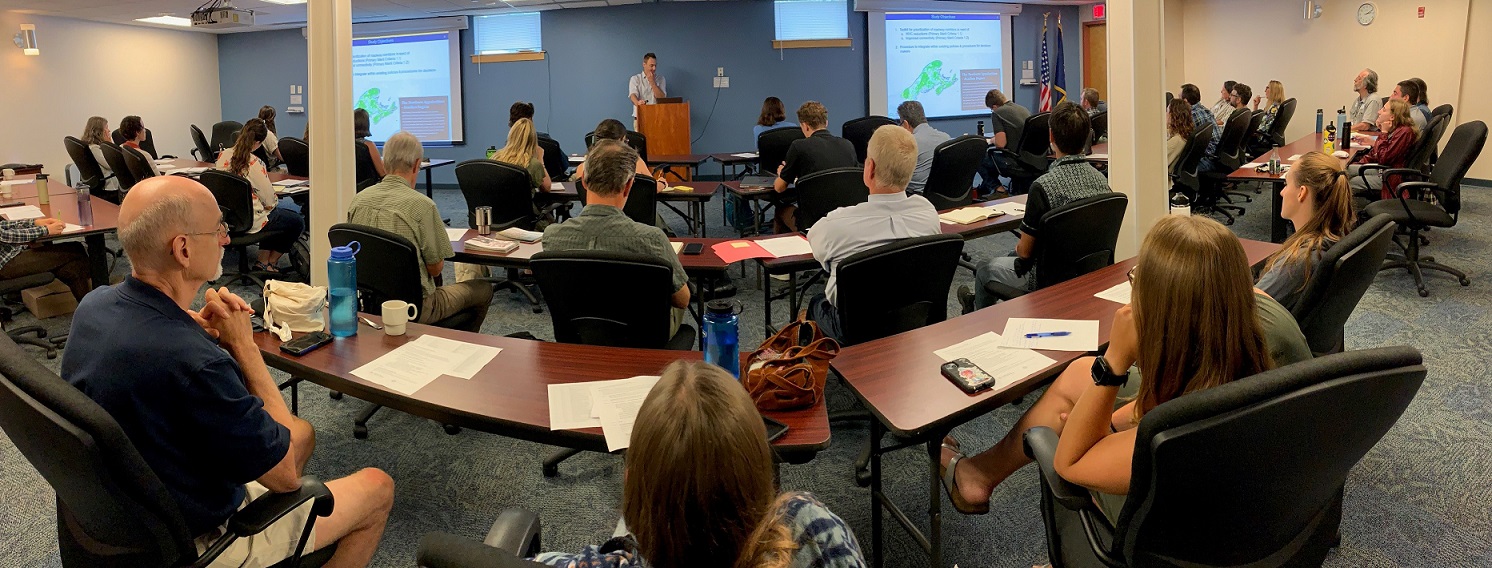
Our Team
Staff
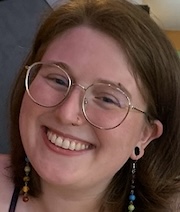
Penny Adler-Colvin
Conservation and Land Use Specialist | Contact
Penny joined the Estuary Program in 2025, following six years at the Mohonk Preserve, a non-profit land trust where she worked with the land protection, conservation science, and environmental education teams. While at Mohonk, Penny engaged community scientists in initiatives including peregrine falcon monitoring, phenology observations, and stream health monitoring. They have interests in community engagement, GIS applications for conservation, and land protection. Penny earned a Bachelor of Science in Environmental Geography from the State University of New York at New Paltz.
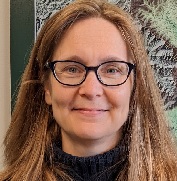
Christine Vanderlan
Conservation and Land Use Specialist | Contact
Christine provides technical assistance and conducts outreach to municipalities and other partners in the watershed to help advance local conservation planning. She joined the Estuary Program in 2022. Originally from the Mohawk Valley, Christine began her work in the region at the Columbia Land Conservancy where she hosted the Roundtable for Conservation Advisory Councils, worked with partners to develop the Taghkanic Headwaters Conservation Plan, and assisted in strategic conservation planning. Christine served in the US Peace Corps in Guatemala supporting agroforestry initiatives. She earned a Master’s of Science in Biodiversity, Conservation, and Policy from the University at Albany.
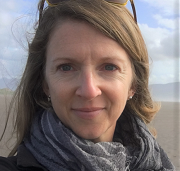
Laura Heady
Conservation and Land Use Program Coordinator | Contact
Laura Heady leads the Conservation and Land Use Team at the Hudson River Estuary Program. She has 20 years of experience working to advance biodiversity conservation in the Hudson estuary watershed by creating and implementing innovative programs in conservation planning and community engagement; developing new partnerships; and contributing to NYS policy and planning initiatives. Laura also has interests in science communication, habitat connectivity, and strategic planning and is the founding manager of the volunteer Amphibian Migrations & Road Crossings Project. She earned her Master's of Science degree in biology with an emphasis in ecology from Idaho State University. Read more about Laura here.
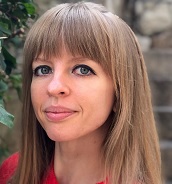
Dr. Daria Ponstingel
Postdoctoral Associate | Contact
Daria Ponstingel is a postdoctoral associate at the Department of Natural Resources and the Environment. Daria earned her PhD in Geography from Texas State University at San Marcos. Her research investigates human aspects of environmental well-being, including how decision-making, governance, and policy affect the outcomes of socio-ecological systems, and how these impacts can be managed and regulated. Daria uses GIS and remote sensing techniques to analyze ecological change and evaluate ecosystem services, such as carbon sequestration. In her work, Daria also applies diverse economies and Ostrom’s frameworks to understand human behavior in natural resource management.
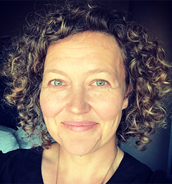
Dr. Ginger Allington
Principal Investigator | Contact
Ginger Allington is an Assistant Professor in the Department of Natural Resources and the Environment, and a member of the graduate field in Natural Resources. Prior to joining Cornell University, Dr. Allington was an Assistant Professor in the Department of Geography at George Washington University. Dr. Allington is an inter-disciplinary human-environment scholar, trained as a landscape ecologist and socio-environmental system scientist. She is broadly interested in the application of systems-thinking and integrated system models to resource management challenges. Her research is focused on measuring, mapping and modeling change in complex socio-environmental systems, particularly focused on arid rangelands in Central Asia. Dr. Allington has been Principal Investigator for this program since 2025. Read more about Ginger’s research and teaching interests here.
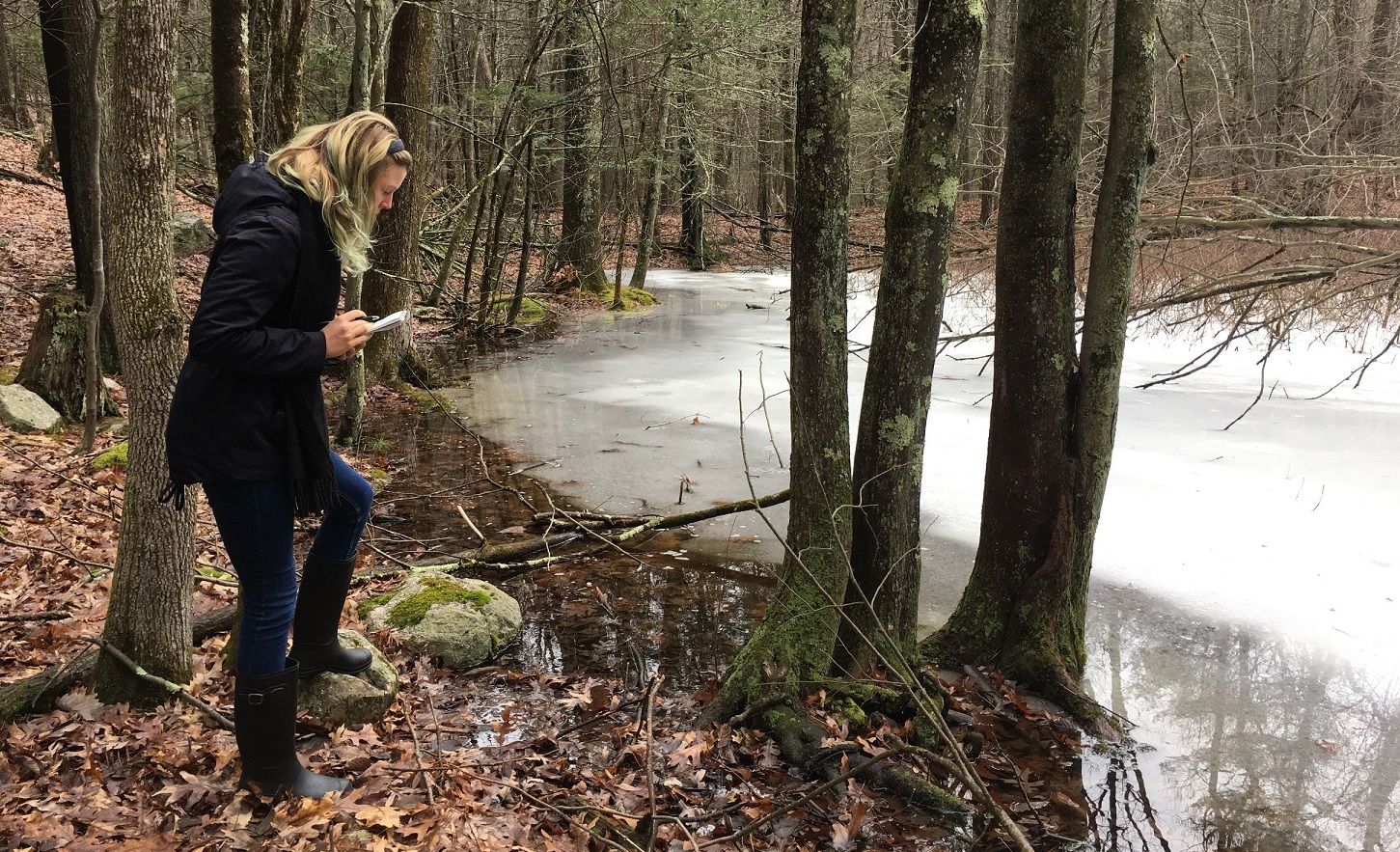
Hudson Valley Conservation Partners
We are fortunate to work with many partners on outreach, planning, and development of new data and tools to advance conservation in the Hudson River estuary watershed. The successful implementation of our program relies on this collaborative and ever-growing network of state agencies, conservation organizations, land trusts, and academic institutions.